
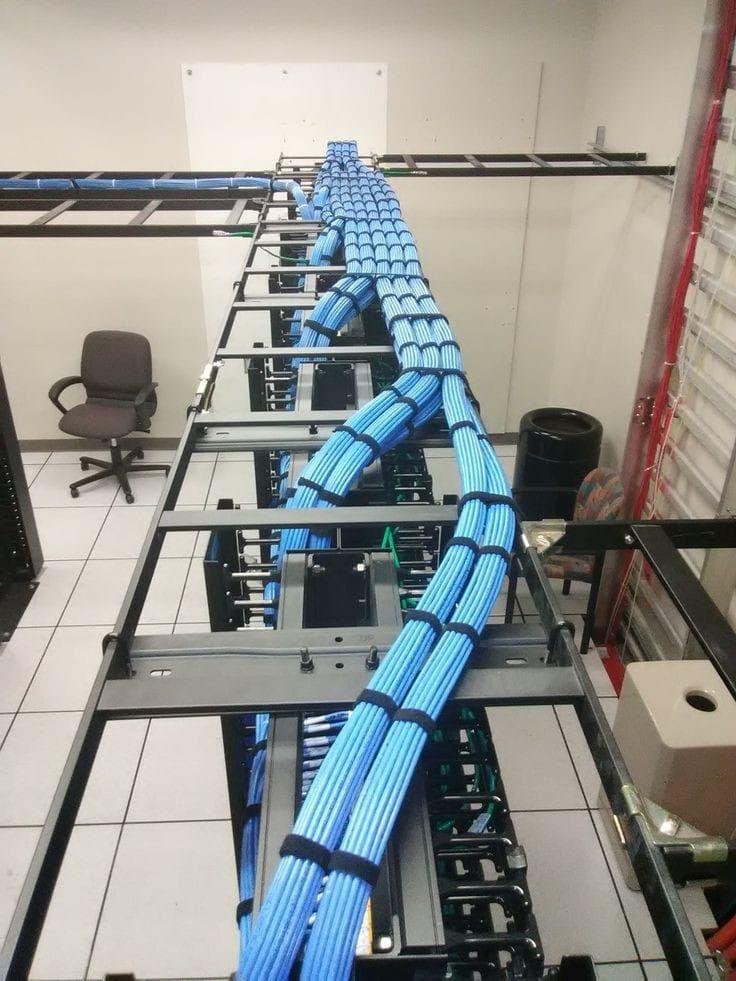
Tired of “cable spaghetti” in your server room? Shan Network provides Patch Panel Installation across Saudi Arabia, including Riyadh, Jeddah, and Dammam.
We don’t just plug in wires we organize, label, and optimize your racks using Cat6, Cat6A, or Fiber. This makes your network easy to manage, simple to fix, and ready to grow with your business. Get a clean, high-performance setup today.
Patch panel installation saudi arabia is key in Saudi Arabia. It supports structured cabling saudi arabia. This cabling is used in offices. It is also used in warehouses, hospitals, and enterprise buildings. It keeps all network cables in one central rack. This setup makes maintenance, troubleshooting, and scaling much easier.
In Saudi Arabia, installation costs usually range from SAR 1,500 to SAR 25,000. This depends on factors like the number of ports, rack size, and if it’s part of a full lan network installation saudi arabia or enterprise network setup.
In my work with offices in Riyadh, Jeddah, and Dammam,
I’ve noticed something. Most network issues don’t come from internet providers. They often come from messy network rack cabling saudi arabia organization and missing or wrongly installed patch panels. This guide covers patch panel installation. It includes costs in SAR, tips for Saudi Arabia, a step-by-step setup, and common mistakes businesses make.
Muhammad Shan is an IT infrastructure specialist. He has over 8 years of experience in structured cabling and network rack design. He has worked across Saudi Arabia. He has worked on office, warehouse, and enterprise network projects. These projects use patch panels and server racks. They also involve fiber and copper cabling systems. For more information, visit shannetworkcompany.com.
Expertise includes:
Patch panel installation & labeling systems
Structured cabling design (Cat6 / Cat6A / Fiber)
Server rack organization
LAN & enterprise network planning
Data center cable management
A patch panel is a central connection point in a network rack where all Ethernet cables from different parts of a building terminate. Instead of connecting cables directly to switches or routers, they first go into a patch panel. Think of it like a traffic control hub inside your office network.
For example: Office desks → Ethernet cables → Patch panel → Switch → Router → Internet
Without a patch panel, cables become messy, difficult to manage, and nearly impossible to troubleshoot. In Saudi Arabia, structured cabling saudi arabia is common. This is especially true in the business areas of Riyadh and Jeddah. Patch panels are now standard for IT infrastructure.
What surprises most business owners is this: A well-installed patch panel does more than organize cables. It also cuts downtime a lot. I once went to an office in Al Olaya, Riyadh. A simple internet issue took 3 hours to fix. The problem? Cables were plugged directly into switches without labels or a network rack cabling saudi arabia system. After installing a proper 24-port patch panel, troubleshooting time dropped to under 10 minutes.
Saudi businesses are expanding fast under Vision 2030, and IT infrastructure must scale with that growth.
Patch panels are essential because they:
Organize network cabling
Reduce maintenance time
Improve scalability
Prevent cable damage
Support structured troubleshooting
In environments like:
Corporate offices in Riyadh
Warehouses in Dammam industrial zones
Hospitals in Jeddah
Hotels near Makkah
NEOM smart city projects
…network reliability is critical.
A poorly organized rack can lead to:
Network downtime
Misconfigured connections
Slow troubleshooting
Hardware overheating
Expensive maintenance delays
In Saudi Arabia, summer temperatures often exceed 45°C. This heat can lead to more hardware failures. Poorly managed racks make the risk even higher.
You don’t need a license for patch panel installation saudi arabia. But, it must follow structured cabling standards used in businesses.
Key authorities and standards include:
Communications, Space & Technology Commission (CST) https://www.cst.gov.sa/en
Saudi Standards, Metrology and Quality Organization (SASO) https://www.saso.gov.sa
Ministry of Communications and Information Technology (MCIT) https://www.mcit.gov.sa
International standards commonly followed:
TIA/EIA-568 structured cabling standard
ISO/IEC 11801 cabling standards
ANSI/TIA rack & patch panel guidelines
In Saudi enterprise projects, documentation is often required including:
Cable labeling maps
Rack diagrams
Port assignment records
Testing reports
Since 2025, many large projects in Riyadh and NEOM require full digital documentation of network infrastructure for compliance and maintenance tracking.
The first step is planning how many ports are needed.
Typical setups:
Small office: 12–24 ports
Medium office: 24–48 ports
Enterprise: 48–96+ ports
Each desk, printer, CCTV camera, and access point must be mapped.
In Saudi offices, planning mistakes often happen when companies underestimate future expansion.
A server rack is installed or prepared.
This includes:
Rack mounting
Power distribution unit (PDU) setup
Cooling considerations
Cable management trays
In Saudi Arabia, proper ventilation is critical due to high ambient temperatures.
All Ethernet cables are routed from workstations to the rack.
Then they are terminated into the patch panel using punch-down tools.
This step requires precision.
Bad termination leads to:
Signal loss
Network instability
Intermittent connectivity issues
Each port is labeled clearly:
Example:
HR-01
CCTV-03
IT-Server-02
Without labeling, troubleshooting becomes extremely difficult later.
In many Saudi offices I’ve worked with, lack of labeling was the biggest hidden problem.
Short patch cords connect patch panel ports to network switches.
This allows easy reconfiguration without touching main cabling.
For example:
Moving employee desk = just change patch cable
No need to re-pull cables
Each connection is tested using cable testers to ensure:
Proper connectivity
No signal loss
Correct wiring standard (T568A/B)
Professional installations always include test reports.
A consulting firm in Jeddah had frequent network outages.
Initial setup:
No patch panel
Direct switch connections
No labeling
Problems:
Frequent disconnects
Difficult troubleshooting
Cable confusion during expansion
Solution implemented:
Installed 48-port patch panel
Structured cabling redesign
Full labeling system
Cost: SAR 9,500 Time: 2 days
Results:
80% faster troubleshooting
Zero downtime from cable errors
Easy expansion for new employees
Type
Best For
Ports
Price Range (SAR)
Cat6 Patch Panel
Small offices
12–24
150–500
Cat6A Patch Panel
Modern offices
24–48
400–1,200
Fiber Patch Panel
Enterprise/data centers
12–96
800–5,000+
Best for standard office environments.
Affordable and widely used.
Higher performance and future-ready.
Recommended for growing businesses in Saudi Arabia.
Used in:
Data centers
Telecom infrastructure
Large enterprise networks
Pricing depends on:
Number of ports
Rack complexity
Cable type
Labor requirements
As of 2026:
Project Type
Cost Range
Small Office Setup
SAR 1,500–5,000
Medium Office
SAR 5,000–12,000
Enterprise Setup
SAR 12,000–25,000+
Cheap installations often skip:
Proper labeling
Testing
Cable management
Which creates long-term issues.
Direct switch connections cause chaos during troubleshooting.
Leads to confusion and downtime.
Poor airflow leads to overheating in Saudi climate.
Cheap hardware leads to loose connections.
Businesses quickly run out of ports.
Always install at least 20–30% extra ports
Use color-coded cables for departments
Keep rack airflow open
Document every port
Separate CCTV and data networks
Professional testing tool for network certification https://www.fluke.com
Enterprise switches and infrastructure https://www.cisco.com
SMB-friendly networking ecosystem https://www.ui.com
Telecom regulatory authority https://www.cst.gov.sa/en
Patch panel installation is the process of centralizing all your building’s network cables. This usually happens in a server rack. Our technicians end each wire at its own port. This makes a clean and organized “dashboard” for your network. This setup lets you easily connect, disconnect, or move devices. You won’t have to touch your expensive switches directly.
2. How much does patch panel installation cost in Saudi Arabia?
In the Saudi market, professional installation typically ranges from SAR 1,500 to SAR 25,000.
The final price depends on a few factors:
The number of ports, like 24-port or 48-port panels.
The type of cable, such as Cat6 or Cat6A.
The complexity of the cable dressing needed.
For businesses in Jeddah or Riyadh, this investment offers a long-lasting, maintenance-free network.
Why is a professional patch panel important for your office?
A patch panel acts as the “brain” of your physical network, preventing the chaotic “cable spaghetti” that leads to network downtime. It makes troubleshooting easier. Every connection is clearly visible and labeled. This helps your IT team save hours during repairs. It also keeps your networking hardware safe from damage. This helps your expensive equipment last longer.
Can I install a patch panel without professional help?
You can manage a small home setup. However, enterprise-grade installations in KSA need expert help. This is important to meet international TIA/EIA standards. Professional installers use precise tools for termination. They use Fluke testers, too. This ensures there is no signal loss. Doing it yourself often leads to “packet loss” or weak connections that can slow down your entire business operation.
How long does the installation process usually take?
For a standard small office, we can typically complete the installation and testing within 1–2 business days. Larger corporate systems or data centers with many racks can take up to a week. This time is needed to make sure every cable is routed, terminated, and labeled correctly. We always aim for a quick turnaround to minimize any disruption to your daily business activities.
Saudi Arabia is moving toward:
Smart structured cabling systems
Fiber-first network infrastructure
Automated rack monitoring
AI-based network diagnostics
Patch panels remain a core part of physical network infrastructure despite digital transformation.
Patch panel installation may seem like a small detail, but it is one of the most important foundations of a stable network.
In Saudi Arabia’s fast-growing business environment, properly structured cabling ensures reliability, scalability, and long-term cost savings.
Get the latest updates via email. Any time you may unsubscribe.